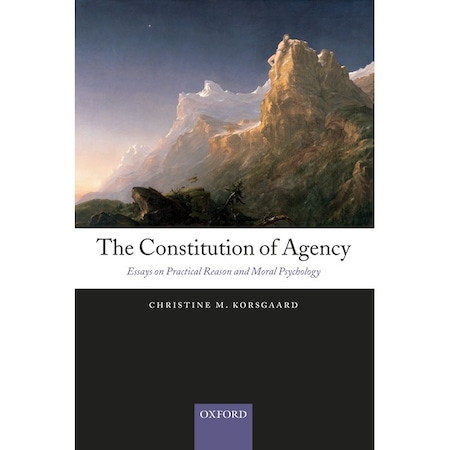
Christine
M.
Korsgaard
is
one
of
today's
leading
moral
philosophers:
this
volume
collects
ten
influential
papers
by
her
on
practical
reason
and
moral
psychology.
Korsgaard
draws
on
the
work
of
important
figures
in
the
history
of
philosophy
such
as
Plato,
Aristotle,
Kant,
and
Hume,
showing
how
their
ideas
can
inform
the
solution
of
contemporary
and
traditional
philosophical
problems,
such
as
the
foundations
of
morality
and
practical
reason,
the
nature
of
agency,
andthe
role
of
the
emotions
in
n/a
Part
1,
The
Principles
of
Practical
Reason
,
Korsgaard
defends
the
view
that
the
principles
of
practical
reason
are
constitutive
principles
of
action.
By
governing
our
actions
in
accordance
with
Kant's
categorical
imperative
and
the
principle
of
instrumental
reason,
she
argues,
we
take
control
of
our
own
movements
and
so
render
ourselves
active,
self-determining
beings.
She
criticizes
rival
attempts
to
give
a
normative
foundation
to
the
principles
of
practical
reason,
challenges
theclaims
of
the
principle
of
maximizing
one's
own
interests
to
be
a
rational
principle,
and
argues
for
some
deep
continuities
between
Plato's
account
of
the
connection
between
justice
and
agency
and
Kant's
account
of
the
connection
between
autonomy
and
agency.
In
Part
II,
Moral
Virtue
and
Moral
Psychology
,
Korsgaard
takes
up
the
question
of
the
role
of
our
more
passive
or
receptive
faculties
-
our
emotions
and
responses
-
in
constituting
our
agency.
She
sketches
a
reading
of
the
Nicomachean
Ethics
,
based
on
the
idea
that
our
emotions
can
serve
as
perceptions
of
good
and
evil,
and
argues
that
this
view
of
the
emotions
is
at
the
root
of
the
apparent
differences
between
Aristotle
and
Kant's
accounts
of
morality.
She
argues
that
infact,
Aristotle
and
Kant
share
a
distinctive
view
about
the
locus
of
moral
value
and
the
nature
of
human
choice
that,
among
other
things,
gives
them
account
of
what
it
means
to
act
rationally
that
is
superior
to
other
accounts.
In
Part
III,
Other
Reflections
,
Korsgaard
takes
up
question
how
we
come
to
view
one
another
as
moral
agents
in
Hume's
philosophy.
She
examines
the
possible
clash
between
the
agency
of
the
state
and
that
of
the
individual
that
led
to
Kant's
paradoxical
views
about
revolution.
And
finally,
she
discusses
her
methodology
in
an
account
of
what
it
means
to
be
a
constructivist
moral
philosopher.
The
essays
are
united
by
an
introduction
in
which
Korsgaard
explains
their
connections
to
each
other
and
to
her
current
work.
Recenzii
This
is
a
refreshing
piece
of
n/a
volume
collects
ten
influential
papers
by
Christine
M.
Korsgaard,
one
of
today's
leading
moral
philosophers...
They
are
organized
into
three
parts,
and
preceded
by
a
very
rich
Introduction,
which
provides
the
framework
and
the
basic
ideas
developed
in
the
essays...
As
with
any
other
work
of
such
philosophical
importance,
the
essays
in
this
collection
have
initiated
debates
that
will
be
the
foci
of
ethics
and
action
theory
in
the
days
to
come.
Nota biografica
Christine
M.
Korsgaard
earned
her
B.A.
at
the
University
of
Illinois
in
1974,
her
Ph.D.
at
Harvard
University,
where
she
studied
with
John
Rawls,
in
1981,
and
an
LHD
at
the
University
of
Illinois
in
2004.
She
is
currently
Arthur
Kingsley
Porter
Professor
of
Philosophy
at
Harvard
University.
She
works
on
moral
philosophy
and
its
history,
practical
reason,
agency,
personal
identity,
and
the
relations
between
human
beings
and
the
otheranimals.